
From day-to-day to disaster
Venues shaping local preparedness
Presented on December 18, 2025 in collaboration with the National Independent Venue Foundation (NIVF)
Missed the live session?
During the session, we shared the #ReadyWhen QuickStart Inventory, a 5-minute survey that jumpstarts the process of seeing your work through a resilience lens. Looking at the survey results together, the picture reinforces the central insight of the session: the arts & venues sector already holds substantial operational capacity; the opportunity lies in connecting that capacity to formal planning, funding, and public systems.
A few takeaways:
- Many respondents have already managed significant disruptions during events, sometimes multiple times, and a meaningful portion have action plans or protocols in place.
- Most are at least “somewhat familiar” with local hazards and organizational vulnerabilities, even if they have not completed a full risk assessment.
- Top barriers to doing more include limited staff time, funding constraints, competing priorities, and making the case to boards and leadership.
- Participants named logistics coordination, crowd management, communications, and community‑facing programming as strengths they see as transferable during emergencies.
Questions from the chat
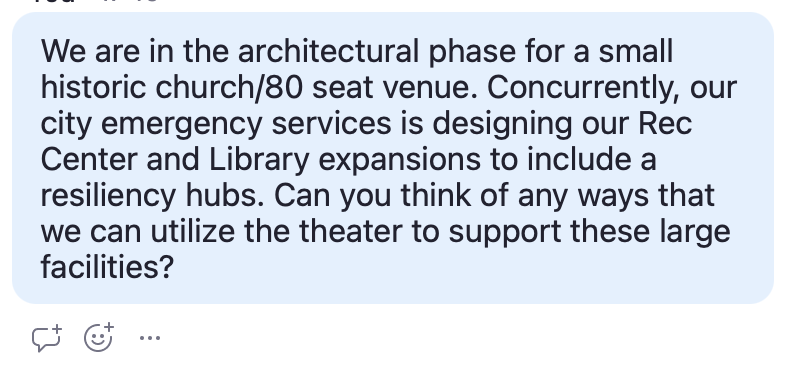
Absolutely glad to hear that the new theater has a resilience hub focus and that Emergency Services is designing it! The main first thought is that there is benefit in these hubs being designed in collaboration across city teams.
We have a survey for Emergency Managers on the ReadyWhen website that might help in getting some data about existing strengths as well as threats/needs. A substantial assessment of the facility and its risk profile to things like flood plane is critical, as well as the grid infrastructure, transportation, accessibility parking etc near by. Access to events/emergency receptacles just outside the building has been something we like to see.
There’s a lot to every project, but if you are working on or thinking about something along these lines, please get in touch! We regularly consult on resilience and disaster readiness projects spanning the arts, culture, and events and emergency planning sectors.
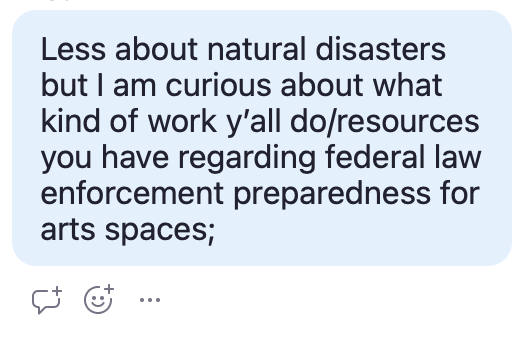
During the webinar, one participant posted a question regarding what to do if federal or other enforcement agents show up at a venue. A practical best practice is to give front‑line staff a short, written protocol (or even a laminated card) so they are not improvising at the door. For example, venues can train staff to:
- Politely ask any person identifying as law‑enforcement or immigration to show government photo ID and agency credentials.
- Request to see any warrant or court order in writing and check whether it is signed by a judge and describes the areas to be entered and/or person(s) to be sought.
- Contact a designated supervisor or legal point person immediately and follow their direction before granting access to non‑public areas.
- Document the visit (names, badge numbers, agency, time, stated purpose, and what was requested or done) in an incident report.
- Clearly distinguishing public from non-public spaces (for example signage like “No Admittance without Authorization”) is a good way to reinforce specific policies.
Practice and role‑play these scenarios during trainings to solidify situational steadiness and help staff stay calm and consistent under pressure.
This guidance is for informational purposes only. This kind of written protocol should be developed and reviewed with legal counsel familiar with your jurisdiction and organizational obligations.